
What Is Tokenization? What Every Engineer Should Know


Tokenization is a commonly used technique for protecting private or sensitive information, for security or compliance reasons. It replaces a sensitive data value, such as a card number or Social Security number, with a non-sensitive token. Systems that never need to read the original value work with the token instead.
Two architectures do this. Vaulted tokenization keeps a mapping table and looks up the original on request. Vaultless tokenization derives each token from a key, with no table to look up at all. The choice sets request latency, how the system scales, and where a breach does its damage, and it holds for the life of the system.
What Is Tokenization?
Tokenization is a data protection technique that replaces a sensitive data value with a non-sensitive token that holds no mathematical relationship to the original value. The mapping back to the original stays with the tokenization service alone.
The PCI Security Standards Council codifies this exact model in its Tokenization Guidelines, where the value at stake is the primary account number (PAN).
The token must have no value to an attacker. An intercepted token reveals nothing, and recovering the original from it must be computationally infeasible.
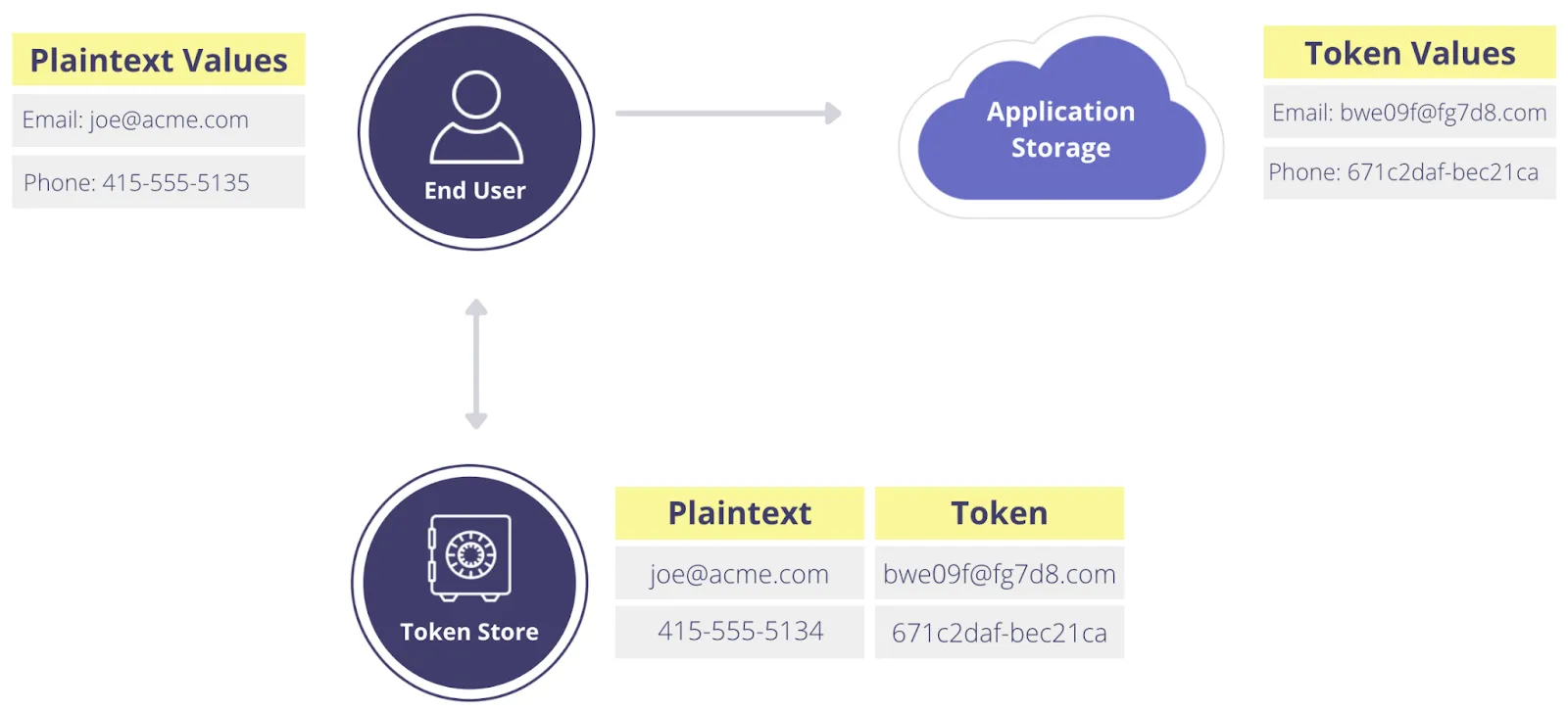
Token Types
Token behavior depends on whether the same input always yields the same token and whether the token keeps the original format.
- Deterministic tokens: The same input always yields the same token, so joins and equality operations work across systems without exposing raw values. Two tables holding the same email address hold the same token, so a join on that column still returns the right rows. The cost is leaked frequency patterns an attacker can analyze on low-entropy columns.
- Non-deterministic tokens: The token has no mathematical relationship to the original value, and recovery runs only through a vault lookup, which suits fields that never need joining, such as one-off transaction records.
- Format-preserving tokens: The token matches the original's length and character set, so a 16-digit card number becomes a 16-digit token. Legacy schemas that validate field formats keep working. PCI DSS also requires tokens to be distinguishable from real PANs, so format preservation is bounded by that rule rather than free-form.
These properties compose freely, so a single field can be both deterministic and format-preserving. The right combination depends on how downstream enterprise systems consume it.
Types of Tokenization
Vaulted tokenization keeps the mapping table. Vaultless tokenization derives tokens deterministically from a key using format-preserving encryption or HMAC, with no central lookup table at all.
- Token generation: Because a vault holds an explicit mapping row, the token itself can be anything. A random number generator can produce it, with no mathematical relationship to the original value and nothing about the original encoded in it. A vaultless token is the output of a cipher or a MAC, computed from the input and the key, which ties the token's security to the algorithm's security.
- Cryptographic dependency: A random vault token has no algorithm behind it, so there is no cryptanalysis to defend against and no migration when recommendations change. Algorithm-derived tokens inherit the lifespan of the algorithm that produced them, which is the problem the post-quantum transition is creating across deployed cryptography today. The vault's own encryption at rest still carries normal crypto-agility obligations. The token-to-value relationship does not.
- Latency: A vault lookup adds a network hop, and every added hop pushes the slowest requests further out, straight into the 95th and 99th percentile response times that matter most under load. A key-derived token skips that hop entirely, trading network latency for the cost of key access instead.
- Scalability: The tokenization service adds entries to the vault's mapping table and must keep its replicas consistent as that table grows across regions and traffic scales. Key-derived tokens skip the table altogether and put every token's security into a single key.
- Reversibility: The two vaultless mechanisms are not interchangeable. Format-preserving encryption is reversible with the key. An HMAC is not, so HMAC-derived tokens support equality matching but never return the original value.
- Attack surface: Vaulted tokenization risks exposing both original values and their tokens in a single database breach. In contrast, vaultless tokenization shifts risk to the encryption algorithm and key; compromising either exposes all tokens created with that key.
Choosing between them is an architecture decision made once, up front. The mechanism both share once a token exists works the same way regardless of which one a team picks.
How Tokenization Works
The tokenization service flags fields at capture, generates and binds a token , moves the original into protected storage, and returns the raw value only when policy authorizes it.
Data Capture and Identification
The tokenization layer flags sensitive fields at intake, before they touch application logic. For structured data, that means designating columns for card numbers or SSNs, plus email addresses, at the API layer; Documents and chat prompts need detection first, since no field name flags an SSN in free text.
Token Generation
The service can produce a token with a reversible cryptographic function, a non-reversible one-way function such as a salted hash, or an index, sequence, or random number that holds no mathematical relationship to the original value. The service records the token-to-value mapping at generation time for randomly assigned tokens and recomputes derived tokens from the key on demand.
Secure Storage and Mapping
With randomly assigned tokens, the original value and its mapping live in a vault protected by KMS- or HSM-backed keys, fine-grained access controls, and audit trails.
Detokenization on Authorized Retrieval
Detokenization exchanges a token for its original value, and only approved callers or workflows hold that right. The tokenization service checks each request against policy and logs it. Under PCI DSS, any system with access to detokenization is in scope, so fewer components with that access means a smaller audited footprint.
Tokenization vs. Encryption
Both encryption and tokenization make sensitive data unusable to anyone without authorized access, and both reversible tokens and ciphertext can be restored to the original value.
The difference is in how the original comes back. Encryption is mathematically reversible by anyone holding the key. A randomly assigned token has no such relationship, so the only way back is an authorized vault lookup. The PCI SSC notes that when a service uses reversible encryption to generate a token, the result is an encrypted PAN and may carry additional PCI DSS considerations.
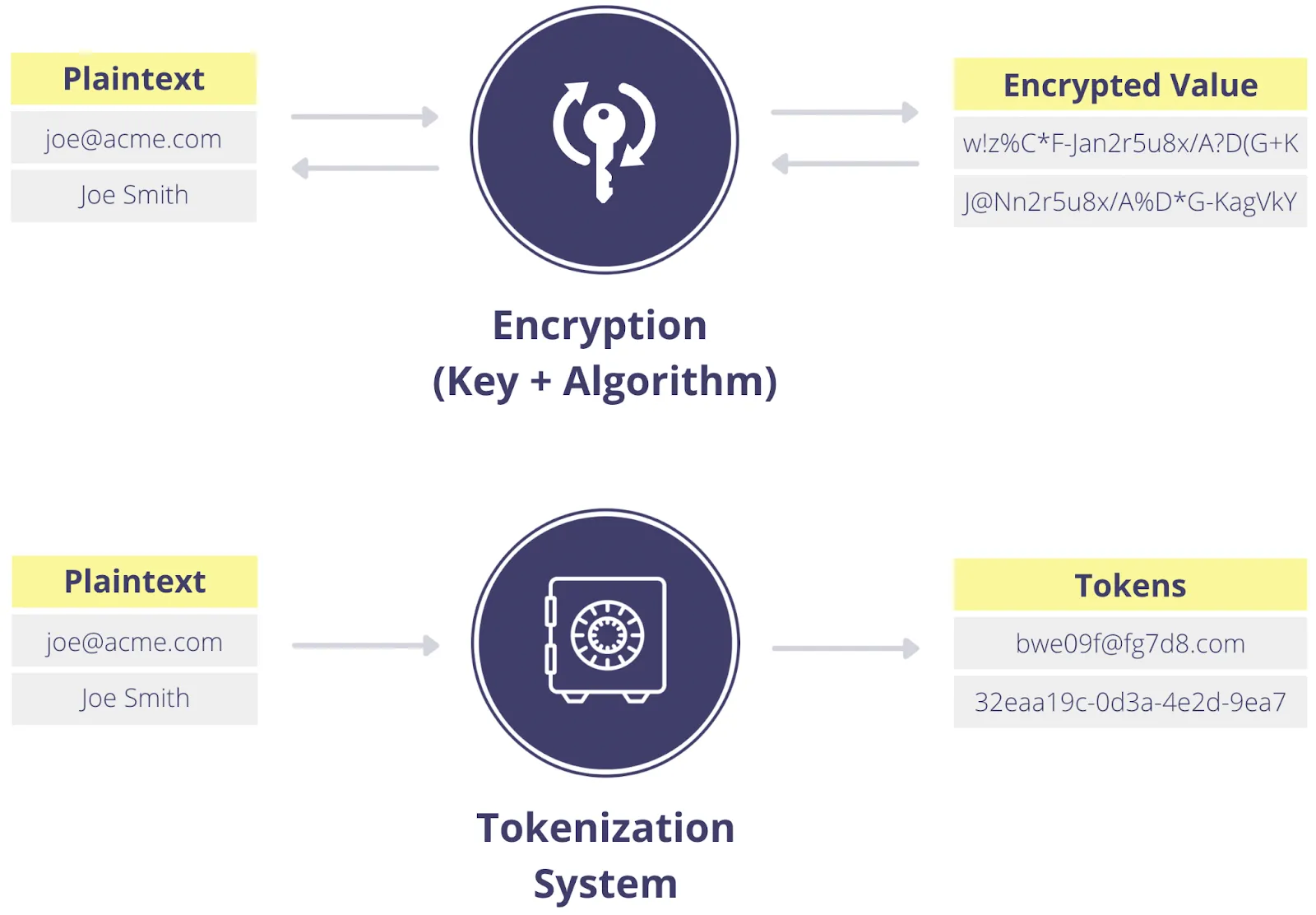
Reversibility, key handling, and compliance scope diverge as follows:
Encryption and tokenization are complementary controls rather than competing alternatives.
Many production systems encrypt the vault contents while tokenizing the values that leave it, combining the confidentiality guarantees of one with the scope-reduction benefits of the other.
How Tokenization Protects Sensitive Data
Tokenization shrinks the blast radius of a breach. An attacker who takes a database or analytics warehouse full of tokens gets values that require vault access to resolve. The 2025 Verizon Data Breach Investigations Report found payment data made up just one percent of compromised data types, a decline it credits partly to wider adoption of tokenized card-not-present transactions.
- PII: Tokenizing names and contact details, along with SSNs, at capture lets downstream systems operate on tokens
- PHI: Tokenizing clinical records narrows what leaves clinical systems. Tokenization alone does not de-identify data under HIPAA, since HHS guidance treats a code derived from an unsalted hash as an identifying element.
- PCI: Tokenization shrinks how many system components store, process, or transmit cardholder data. The PCI SSC says token-only systems may fall outside the CDE only when the architecture meets all six isolation conditions. Those conditions include no detokenization access and no connection to the cardholder data environment.
- Payment tokenization: Card networks run tokenization at scale under the EMVCo Payment Tokenization framework. A network token has the same length and format as the PAN, and each transaction carries a one-time cryptogram. A token service provider can delete a token from a lost device and issue a replacement without changing the PAN or replacing the card.
Each of those protections rests on a tokenization service that answers every call under live traffic, and keeping one running is its own engineering commitment.
Core Requirements for Implementing Tokenization
Operating a tokenization service is harder than building one. It sits in the critical path of every query touching sensitive data. It must also survive key rotations and schema changes while producing evidence for audits.
- Vault management and uptime: The vault is the highest-value target in the architecture and a synchronous dependency for every tokenize and detokenize call, so an outage or breach there stops production traffic rather than degrading one workflow.
- Key rotation and lifecycle: Cloud KMS rotation changes only the key material and does not re-encrypt data that the key already protects, so re-encryption is a migration run with both key versions live. Changing a derivation key changes every deterministic token, while random vault tokens survive rotation because the service re-encrypts only the stored mapping.
- Deterministic joins across systems: Queries and pipelines silently return incomplete results when different tables use different tokens for the same value. Deterministic tokenization solves that, but the token changes whenever the underlying value changes, so updates must synchronize everywhere the token appears.
- Per-field policy control: A fraud analyst needs full card numbers; a support tool needs only the last four digits. One blanket detokenization policy either over-exposes data or breaks workflows, so access rules attach to individual fields and roles.
- Multi-framework compliance mapping: PCI DSS mandates strong cryptography, HIPAA makes encryption an addressable specification, and GDPR treats tokenized data as still personal data whenever a re-identification path exists. Breach clocks conflict too: 72 hours under GDPR, 60 days under HIPAA, immediately for payment brands under PCI DSS.
Engineering leaders base the buy-versus-build decision on these standing commitments.
How Skyflow Delivers Tokenization
Skyflow is a Runtime AI Data Control Platform that isolates sensitive data in a vault, including PII alongside PCI and PHI. It controls what flows to applications, models, and agents at the moment of access. It packages those hard parts (vault operations, key lifecycle, deterministic tokens, per-field policy) behind an API and SDKs, and maps audit evidence to PCI DSS, HIPAA, and GDPR. A compromised downstream enterprise system yields tokens rather than exploitable values.
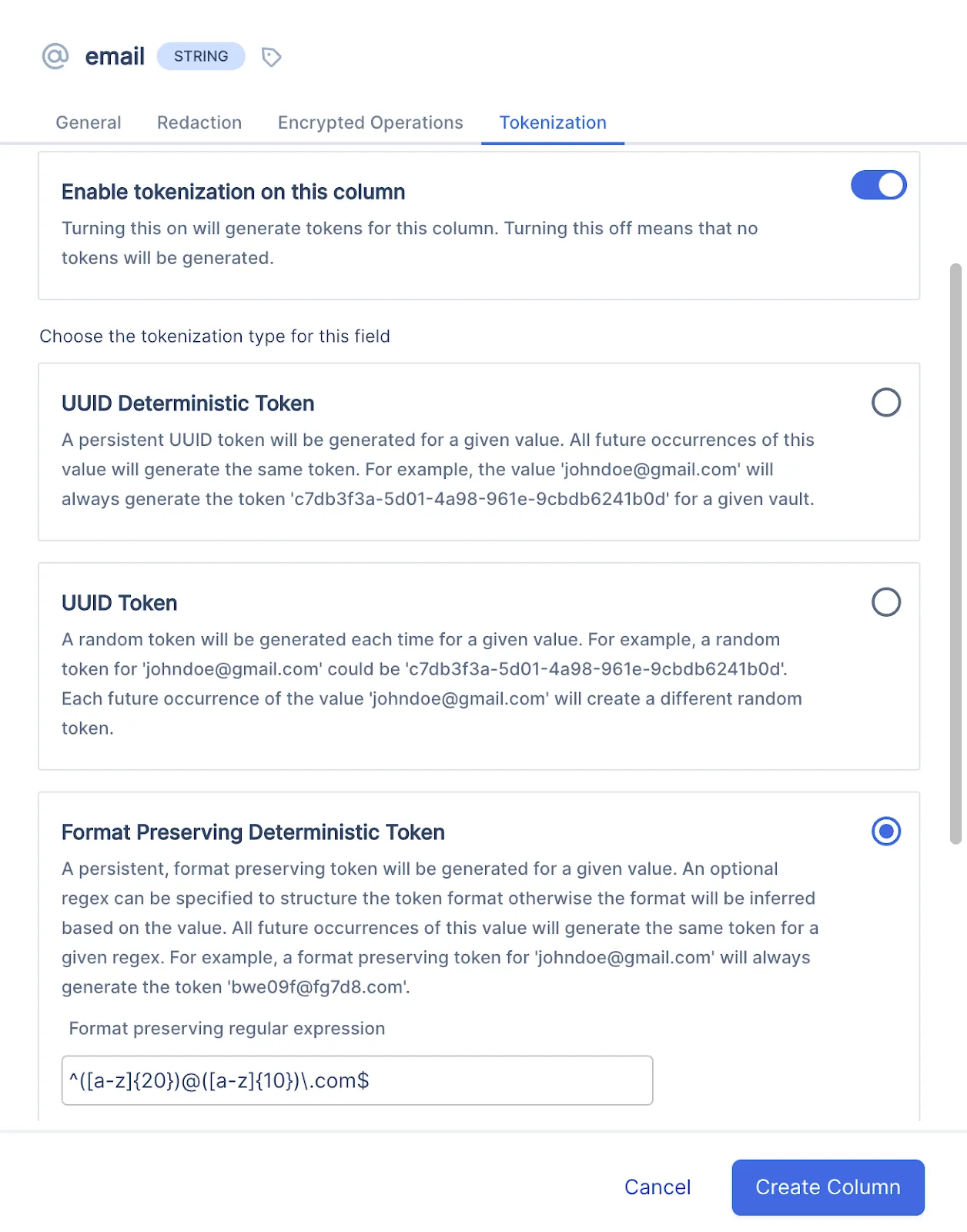
Vault-Based Tokenization with Polymorphic Encryption
Skyflow's vault architecture ensures sensitive data is stored in a schema the team defines, with tokenization behavior set per column. That means deterministic tokens where analytics needs joins, non-deterministic where nothing joins, and format-preserving tokens where a legacy schema validates field length. Polymorphic encryption keeps values protected while queries run against them, so a a query does not need to decrypt / perform a decryption.
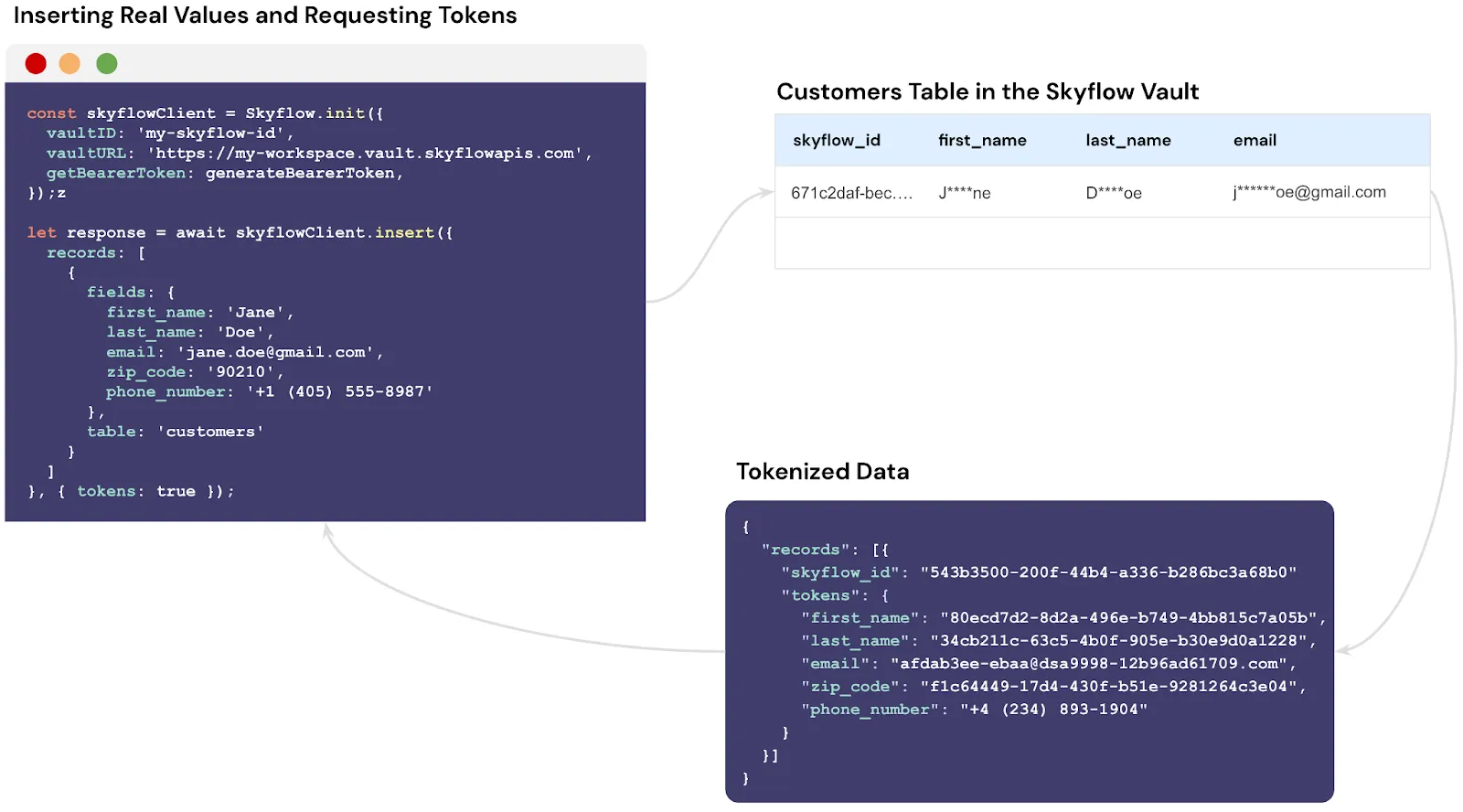
Policy-Based Access and Detokenization
PBAC grants column- and row-level access by role and policy rather than by blanket credential. Applications work with tokens end to end and call the Detokenize API only when policy authorizes it, and each field comes back fully, masked, or redacted depending on the requester. Skyflow logs every access, so producing audit evidence is a query.
Tokenization for AI and Agents
The common instinct is to keep sensitive data out of the model altogether. That collapses the moment a support agent needs the customer's actual account history to answer the question, which makes the problem one of control at runtime rather than exclusion up front. Skyflow intercepts data payloads at runtime, before they reach LLMs or agent infrastructure such as MCP servers, and replaces sensitive elements with tokens or redactions. The same deterministic stand-in appears for a given value throughout a conversation, so the model's output stays coherent. Skyflow detokenizes authorized responses on the way out under the end user's policy.
Secure Sensitive Data with Skyflow
Tokenization makes sensitive data worthless to anyone without authorized access while keeping it usable for the joins and analytics a business runs on. Running that in production means operating a vault and rotating keys without breaking tokens. It also requires field-level policy enforcement and evidence for multiple regulators.
As customer data flows into models and agents, the number of systems touching sensitive values grows faster than the controls around them. The constraint that follows is not security for its own sake. It is whether an AI initiative can use production data at all. Skyflow's Runtime AI Data Control Platform is built to remove that constraint rather than manage around it.
Frequently Asked Questions About Tokenization
How does tokenization differ from encryption?
Encryption transforms data mathematically with a key, and anyone holding that key can reverse it. A vault-based token has no such relationship, so recovery requires an authorized lookup rather than a key.
What is the difference between Vaulted and Vaultless Tokenization?
Vaulted tokenization stores a token-to-value mapping in a secured service; vaultless derives tokens from a cryptographic key with no lookup table. The vault adds a lookup hop and allows purely random tokens with no algorithm behind them. Vaultless rests on the algorithm and key, and when that key feeds an HMAC rather than a cipher, the token cannot be reversed at all.
How does tokenization help meet PCI DSS compliance?
Replacing stored PANs with tokens reduces the number of systems that store, process, or transmit cardholder data, which is what determines assessment scope. Per PCI SSC guidance, assessors may exclude token-only systems from the cardholder data environment when the architecture meets all six isolation conditions. Tokenization reduces scope; it never eliminates PCI DSS obligations.
Is tokenization in AI the same as data security tokenization?
No. LLM tokenization splits text into small units the model processes, roughly four characters per token in OpenAI's models, and it protects nothing. Data security tokenization replaces sensitive values with non-sensitive tokens. The two meet when a platform tokenizes sensitive fields before a prompt reaches the model, so the LLM tokenizes stand-ins instead of actual data.