
How to Manage AI Data Security and Privacy Risks across the Full Model Lifecycle

AI absorbs real customer data faster than most enterprise data architectures can control and govern. Prompts carry sensitive data into provider logs, while fine-tuning jobs bake customer records into model weights and agents pass sensitive context to tools nobody reviewed.
Locking sensitive data in one place still helps, but it no longer covers the problem. As enterprises connect agents to CRM, HR, and ticketing systems through MCP (Model Context Protocol) servers, exposure now happens at runtime, in the flow of data to models and agents. Engineering and data teams need to de-identify sensitive values before any model, agent, or log sees them, and re-identify the values only for the people authorized to see the actual sensitive identifiers.
This guide covers how data reaches AI models, the security, and privacy risks that follow, the regulations that apply, and the runtime data controls that reduce exposure.
What are AI Data Security and Privacy Risks?
AI data security and privacy risks are the ways sensitive data like PII (Personally Identifiable Information) and BII (business identifiable information) can leak, persist, or be misused as it moves through the full model lifecycle.
That includes what enters training and fine-tuning datasets. It also includes what flows through prompts and retrieved context at inference, plus what appears in outputs and logs, including downstream agent calls.
These risks differ from traditional software risks in two ways:
- Output Unpredictability: A database returns exactly the records it was asked for. A model can emit training data, retrieved documents, or prior conversation content in ways its builders never specified.
- Irreversible Absorption: A database stores personal data as discrete records that can be located and deleted. A model absorbs training data into its parameters as statistical patterns, where no individual record exists to find or remove.
Together, these differences make after-the-fact remediation slow and expensive at best. Deleting a record from a database takes a query. Deleting it from a model can take a retraining run. Security and privacy controls must move upstream to what data reaches the model before training or inference begins.
Core Security and Privacy Risks of Generative AI
The four core risks (leakage, memorization, purpose drift, and agent and tool exposure) form one threat model that spans the lifecycle from training through inference to agent actions. Leakage and agent exposure are security failures, memorization is a privacy failure, and purpose drift is a governance failure. Each stems from the same underlying problem: sensitive data flowing to systems with no field-level control over what they receive or retain.
Data Leakage and Unauthorized Disclosure
Every prompt containing a customer's Social Security number is a disclosure event, whether or not the model ever repeats it. At agent speed, the action finishes before anyone reads the alert.
Sensitive values surface in completions, provider-side logs, and cached context. Model providers retain inference data by default. For instance (as of Oct 2026) OpenAI holds API data up to 30 days for abuse monitoring, while Anthropic deletes API inputs and outputs within 30 days, and both offer zero data retention only to approved customers or under a separate agreement.
Model Memorization and Regurgitation
Models reproduce training data verbatim, and the effect scales with model size. Carlini et al. found larger models memorize two to five times more than smaller ones within a family. Nasr et al. recovered over 10k verbatim training examples from ChatGPT for $200 using a divergence attack. Customer records used in fine-tuning are extractable, so the fix is keeping raw PII out of the fine-tuning pipeline entirely.
Purpose Drift and Secondary Use
Conversation data collected for support can reappear in next quarter's fine-tuning set. GDPR's purpose limitation principle (Article 5(1)(b)) requires that data collected for one purpose not be reused for an incompatible one without a fresh legal basis, and retraining on chat logs rarely clears that bar.
The exposure compounds. Each retraining cycle moves conversational PII deeper into model weights, where the erasure problems described below apply in full.
Agent and Tool Exposure
Agents decide at runtime what data a task needs. They pull records from CRM, HR, and ticketing systems through MCP servers, then pass that context to tools and other agents. Access policies written in advance can't anticipate those requests, so a customer record can land in a system nobody approved for it, with no record of which agent moved it or why.
How Data Enters the LLM
The two main ingestion paths carry very different exposure profiles. Fine-tuning encodes data into model weights, where it is durable and hard to remove. Retrieval-augmented generation (RAG) keeps data external to the model and retrieves it at query time, making it revocable but exposing it fresh on every request. Agents add a third path. Tool results and context from other agents reach the model mid-task, and each hop exposes the data again, the same way RAG does.
Fine-Tuning: Absorbs Data into Weights
Fine-tuning writes customer records directly into the model's weights, where they persist as statistical patterns rather than discrete records that can be located and deleted. Web-scraped training sets carry consent gaps by construction, and once personal data trains a model, GDPR Article 17 erasure requests collide with that permanence.
The EDPB's expert report calls full retraining the method that effectively implements erasure rights but notes the cost is often prohibitive for large models. Approximate machine unlearning remains early-stage research.
Unlearning is neither reliable nor verifiable enough to anchor GDPR compliance, according to the IAPP's assessment. The practical conclusion is to sanitize training data before it reaches the training job, because removal afterward may mean retraining or deleting the model.
RAG: Retrieves Data at Query Time
RAG keeps data external to the model and pulls it in fresh at query time, avoiding baking anything into weights but creating a different exposure. A clinical note or contract full of identifiers flows to the model, and potentially into logs, every time it matches a query.
The European Data Protection Supervisor's guidance on RAG flags this risk. Sensitive data in a connected knowledge base can be retrieved inadvertently, including through prompt injection, and leak into the model's responses. De-identifying unstructured data before indexing keeps retrieval useful without making every query a disclosure.
How to Protect Data across the AI Model Lifecycle
Data minimization comes first. GDPR requires personal data to be "adequate, relevant and limited to what is necessary," and the principle applies to training sets and inference inputs alike.
Every technique below is a fallback for data a team could not avoid collecting:
- Anonymization: Strip or generalize direct identifiers, such as names, IDs, and exact addresses, before data leaves its source. In practice, this rarely holds up on its own, because the remaining attributes are usually still enough to trace back to a person.
- Synthetic Data: Generate artificial records that mirror the statistical shape of real data without copying any individual's actual values, useful for testing, development, and demos that don't need real customer records. It is not a substitute for access controls.
- Encryption in Transit and at Rest: Necessary but insufficient, since data must be decrypted to enter a prompt. Polymorphic encryption narrows that exposure window by allowing search and comparison on protected data without full decryption.
- Policy-Based Access Control (PBAC): Field-level policy determines which model, agent, or person can receive which value. Coarse role checks at the application layer do not reach inside a prompt.
No single technique is sufficient on its own.
Runtime enforcement on the data actually flowing into a model is the last point where policy can intercept sensitive values before they reach a prompt, regardless of what upstream controls missed.
Runtime De-Identification: Tokenize before Inference, Re-Identify After
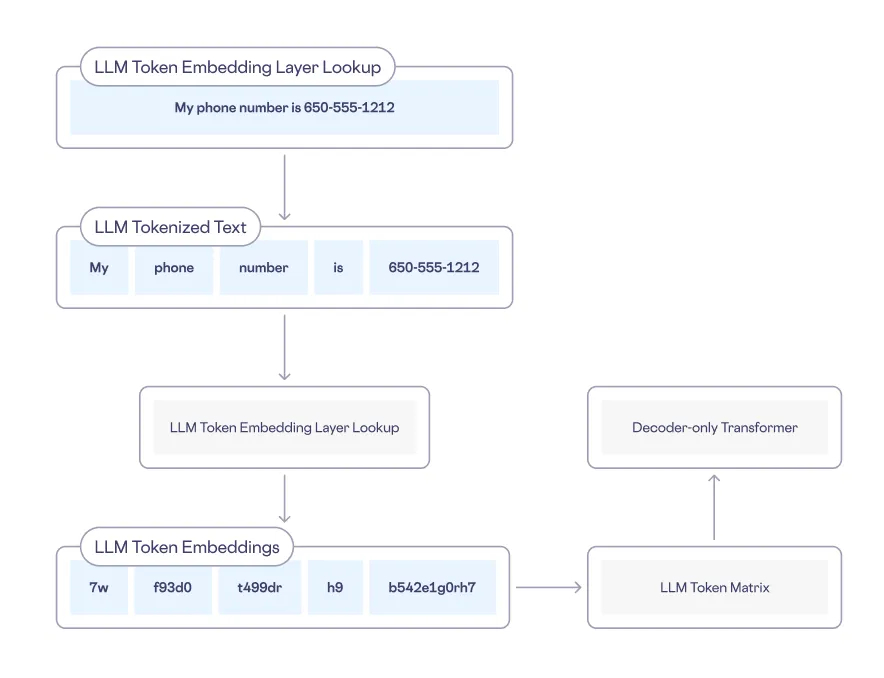
Tokenization-based runtime control takes raw PII and BII out of all four risks closes leakage, memorization, and purpose-drift risks. Engineering and data teams de-identify sensitive data before it reaches any model, agent, or tool, and re-identify it in the response only for authorized recipients.
Tokenize sensitive values in the prompt, retrieved context, or agent payload before inference, so the model receives tokens, not raw PII. The pattern is model-agnostic because the substitution happens outside the model, so swapping providers changes nothing in the security and privacy layer.
The response then goes through a policy-gated detokenization call that re-identifies it, so the authorized person reading it sees real names and account numbers while logs and intermediate systems never hold them.
Policy applies at two independent layers:
- One governs what each model or agent receives, like when a public LLM gets a redacted SSN rather than a blocked request.
- A separate policy governs what each human sees when the response is rehydrated, so auditors and support agents can receive different views from basic users.
A claims agent can confirm a policyholder is over 21 without ever seeing a birth date.
Scrubbers that collapse every entity into a generic label destroy the model's ability to distinguish a patient from a clinician, and without that distinction, any answer that depends on who did what to whom comes back wrong.
Context-preserving tokenization keeps each entity distinct while protecting its raw value, so the model can still reason accurately about relationships and roles. Every prompt and response passes through a detection and tokenization step, which adds a network call teams must budget into their latency plans.
How Skyflow Controls AI Data at Runtime
Every risk in this guide reduces to the same failure: sensitive values reaching a system (a training job, a prompt, a tool, a log) that has no field-level control over what it receives. The lifecycle controls narrow that exposure. Runtime de-identification closes it at the point of use.
Skyflow is a Runtime AI Data Control Platform: it decides what sensitive data flows to models, agents, and systems at the moment of access. The same tokenization engine that protected data for warehouses like Snowflake now governs data flowing to LLMs, agents, and MCP servers. That lets teams bring the clinical notes, call transcripts, and contracts they would otherwise exclude into AI workflows. A single customer value can cross that control layer three to five times in one interaction: on the prompt, the model response, the logs, and each tool call. Platform teams use it to control data at five runtime points:
- Training Data Sanitization: De-identify datasets before fine-tuning, so weights never encode raw PII.
- Agent Input/Output: Tokenize what each agent receives and rehydrate what each user sees, enforced by the two-layer policy model.
- Tool and MCP Protection: The Skyflow MCP server and runtime controls on agent-to-agent (A2A) workflows keep sensitive values out of tool calls, and cross-agent context.
- RAG and Enterprise Search: De-identify unstructured documents before indexing so retrieval returns protected text.
- Observability and Logging: Logs and traces hold tokens, and Skyflow records every access with policy context for audit evidence. Skyflow logs every access with the agent identity, the data accessed, and the policy applied, which gives governance and legal teams a verifiable record of what each agent touched and why.
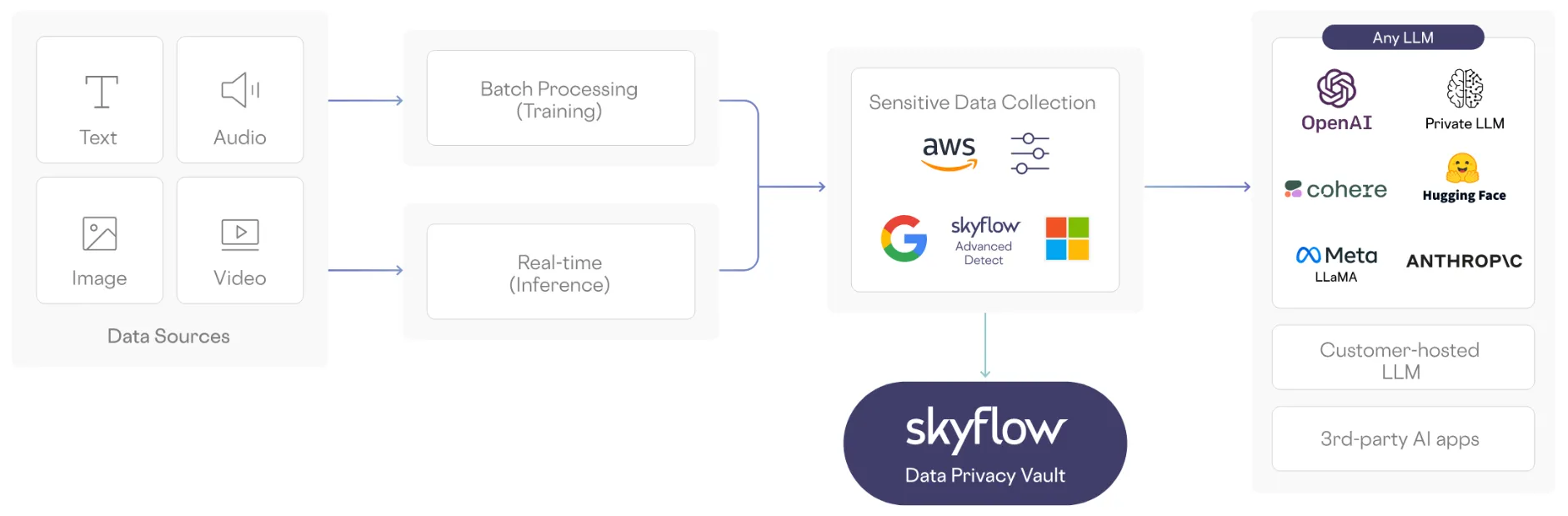
The Detect API does the runtime work: deidentifyText and deidentifyFile handle text, PDFs, audio, and images with context-preserving tokenization, and reidentifyText rehydrates responses under PBAC. Skyflow reduces the blast radius of a breach, so a compromised log, vector store, or agent yields tokens instead of exploitable data.
Control AI Data Before It Reaches a Model
Every stage of this lifecycle, from training data to live agent calls, comes down to the same requirement: sensitive values need a policy decision before a model, agent, or log ever sees them.
One question for the engineering and data teams: how many systems does a single customer SSN touch between the prompt and the log? If the answer is 'we're not sure,' that's the place to start.
Get a demo to see runtime tokenization and re-identification enforced against AI data flows.
Learn how to protect sensitive data in AI applications. Download whitepaper
Frequently Asked Questions About Generative AI Data Privacy
What are the main security and privacy risks of AI across the LLM lifecycle?
Training encodes personal data into weights. Fine-tuning concentrates that risk on a company's own customer records, while inference exposes data through prompts and provider logs, with prompt injection and agent context sharing widening the path.
Purpose drift, reusing conversation data for retraining without fresh consent, cuts across all three stages and violates GDPR purpose limitation.
What is the difference between fine-tuning and RAG for data exposure?
Fine-tuning puts data in weights, where extraction attacks have recovered thousands of verbatim training examples, and removal may require retraining.
RAG keeps data in an external store the operating team can update or delete, but exposes retrieved documents to the model on every query, so the store should hold de-identified text.
What runtime controls prevent data exposure during inference, including in agentic workflows?
De-identify prompts, retrieved context, and agent payloads before they reach any model, then re-identify responses through policy-gated detokenization.
Per-agent policies limit what each step in a multi-agent or MCP chain can receive, and per-user rehydration policies control what each human sees, so a prompt-injected agent or a compromised tool exfiltrates tokens rather than raw customer data.
How do Agentic AI risks differ from Generative AI risks?
Generative AI risks center on what a model absorbs in training and emits in its answers. Agentic AI adds action. Agents request data across systems, call tools, and hand context to other agents at runtime, so data controls have to apply at every hop between them.