
From Panic to Preparedness: Why Skyflow’s Proactive Stance Secures DPDP Act and Rules Compliance


(This blog post is the first in a four-part series on DPDP Act and Rules compliance. The next three parts will delve into the specific rules, beginning with a deep dive into Rule 6)
The Indian Parliament officially enacted the Digital Personal Data Protection Act, 2023 (DPDP Act), in August 2023, marking a crucial step toward regulating the country’s vast digital economy and safeguarding the personal data of its citizens. This comprehensive governmental law enforces strict penalties to ensure that companies prioritize data privacy and security. While the Act laid the foundation, the tangible requirements for compliance were later crystallized through the Digital Personal Data Protection Rules, 2025.
For many enterprises, the release and subsequent effective date of these rules have triggered a panicked scramble for solutions. However, for organizations that recognized the profound shift early on, the transformation has been methodical, guided by sophisticated architectural solutions like Skyflow’s Unified Privacy Platform. Skyflow has consistently led market education and preparation, ensuring that businesses can view the DPDP Act not as a constraint, but as an opportunity for building customer trust and unlocking innovation.
Proactive Foresight and Proven Global Experience
Skyflow’s proactive approach to DPDP Act compliance is rooted in its established global experience in tackling complex data protection challenges, including adherence to frameworks like GDPR, CCPA, HIPAA, and PCI DSS. Recognizing the magnitude of India’s regulatory overhaul, Skyflow began educating the market immediately after the Act's passage in 2023.
This commitment to preparedness was highlighted early in 2025. Following the release of the DPDP Rules, 2025, draft on January 3, 2025, Skyflow proactively published insights, detailing critical operational expectations such as Rule 6 (security-first approach), Rule 7 (data breach accountability), and Rule 14 (Data Principal rights).
This consistent, timely guidance was designed to shift compliance from a reactive burden to a strategic, deliberate project.
Indian enterprises were quick to leverage this expertise. Companies like Dezerv adopted Skyflow's technology early, proactively integrating the platform to tokenize client personal data and strengthen investor trust well ahead of the compliance deadlines. Similarly, Urbanic utilized Skyflow to meet compliance requirements while ensuring the highest security standards. This capability is supported by Skyflow's strong presence in India, including a Bangalore office dedicated to sales and customer implementation. These early movers demonstrate that privacy, when treated architecturally, becomes a competitive differentiation and a brand trust pillar.
The Urgent Reality: Rules are Effective, The Clock is Ticking
The DPDP Rules officially became effective on November 14, 2025. Although organizations have an 18-month window for full compliance (until May 13, 2027), the pressure on enterprises handling sensitive customer data is immediate. The core challenge is addressing Personal Data sprawl - where Personal data is scattered across dozens of systems, including logs, databases, analytics warehouses, data lakes, dashboards, reports, SaaS tools, AI pipelines.
This fragmentation makes compliance with the Act's operational demands nearly impossible using traditional methods:
- Rule 14 (Data Principal Rights): Locating and erasing every copy of a user’s phone number or updating records across fragmented architectures is slow, labor-intensive, and error-prone.
- Rule 3 (Consent): Enforcement of specific, itemized, and easily revocable consent across every system is extremely difficult without centralized control.
- Rule 6 (Reasonable Security Safeguards): Applying consistent encryption, tokenization, masking, access controls and auditability, uniformly across dozens of systems creates inconsistent security and significant gaps.
The consequences of failing to address this sprawl are severe. Non-compliance, particularly the failure to observe reasonable security safeguards (Rule 6), is deemed a significant breach [101(2)], resulting in penalties that may extend to two hundred and fifty crore rupees (approximately $30 million USD) per violation.
The Strategic Solution: Centralized Data Governance
Enterprises facing this urgent transformation do not need to scramble or attempt a lengthy, risky, and expensive in-house build (which can take 18–24 months and 8–10 engineers just for the basics). Skyflow has consistently advocated for its Data Privacy Vault - an approach utilized by major technology firms like Apple, Netflix, and Google for global compliance - which isolates and protects sensitive data separate from existing infrastructure.
Skyflow’s Data Privacy Vault provides a polymorphic privacy engine that solves the conflict between data security and utility. It isolates Personal data, protects it with advanced techniques, and governs all access centrally, while making it fully usable.
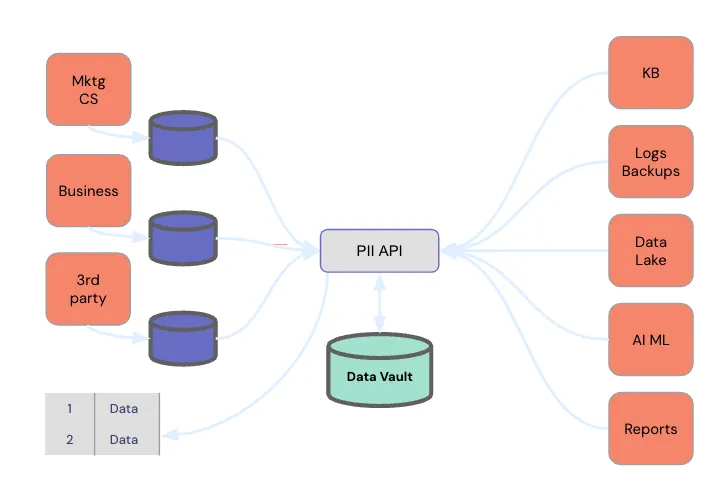
By centralizing control through the data privacy vault, Skyflow enables seamless compliance:
Consent and Rights Enforcement: Consent metadata is stored alongside sensitive data, ensuring that every deletion request (Rule 14) or consent withdrawal (Rule 3) is executed accurately and consistently across all systems with a single API call.
Personal Data Security Safeguards: Protects personal data while processing across all systems using strong privacy-preserving controls. Uses polymorphic encryption, format-preserving tokenization with referential integrity, masking, and obfuscation to keep personal data safe through its entire lifecycle, including inside analytics and AI workflows, for Rule 6.
Audit-Ready Security: Immutable logs and centralized visibility simplify audits and regulatory reviews, providing provable compliance evidence for Rule 6.
The current regulatory pressure underscores the fact that the Data Privacy Vault is the strategic path forward. Skyflow’s platform provides the operational efficiency, auditability, and protection necessary to transform DPDP Act compliance from a fragmented chore into an innovation-friendly capability.
What to expect next from Skyflow
The foundational requirement for this compliance lies in demonstrating Reasonable Security Safeguards under Rule 6. The shift demanded by the DPDP Rules requires moving beyond the limitations of simple, traditional data encryption. To truly secure data and maintain its usability for critical functions like analytics and AI, modern techniques are essential.
This leads directly to the core security conversation: why polymorphic encryption and advanced tokenization offers a truly effective way to protect personal data while keeping it fully usable for business workflows. Unlike basic encryption or masking - both of which break functionality - this approach ensures data remains secure, interoperable, and compliant, enabling organizations (DFs) to meet the security and operational requirements of Rule 6.
Please stay tuned for more information!